 AnatomyCompass
Radius
Radius · Cow · Skeletal system · Thoracic limb
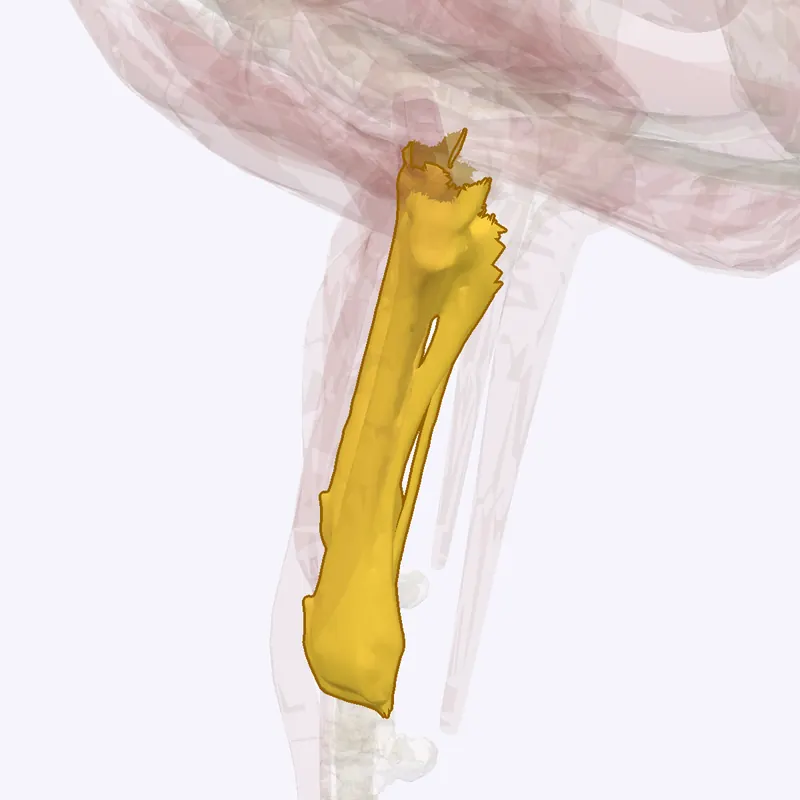
Main bone of the forearm, short and broad in cattle. It transmits almost all the weight from the elbow to the carpus and is rigidly joined to the ulna.
Key points
- Fused to the ulna, the bovine forearm cannot pronate or supinate.
- The medial radial tuberosity receives the insertion of the biceps brachii.
- The medial styloid process is palpable on the medial side of the carpus.
- A cast to the elbow does not immobilise radius and ulna fractures well.
- In septic calves, haematogenous osteomyelitis can settle in the distal radius.
Overview
The radius is, with the ulna, one of the two bones of the forearm. It is the one that transmits the weight of the humerus to the carpus.
In cattle it is short, broad and flattened dorsopalmarly, with a slight dorsal curve.
The ulna runs along its caudolateral surface and, in the adult, fuses with it over much of its length. For this reason the bovine forearm cannot pronate or supinate. Its movement is limited to flexion and extension of the elbow and carpus.
Proximal end
- Head of the radius (caput radii). Broad, with an articular surface (fovea capitis radii) that takes up almost the whole width of the elbow and articulates with the humeral condyle.
- Radial tuberosity (tuberositas radii). On the medial surface, distal to the head. Insertion of the biceps brachii.
- Proximal interosseous space (spatium interosseum antebrachii proximale). Elongated slit between the radius and ulna, distal to the elbow. Vessels pass through it to the dorsal surface of the forearm.
Shaft and distal end
- Shaft. Convex and smooth on its dorsal surface, which is covered by the extensors of the carpus and digits. The ulna lies against its caudolateral surface.
- Distal interosseous space. Small opening between the two bones near the distal end.
- Trochlea of the radius (trochlea radii). Oblique distal articular surface for the radial and intermediate carpal bones.
- Medial styloid process (processus styloideus medialis). Palpable on the medial side of the carpus. The lateral styloid process belongs to the ulna.
Clinical relevance
Radius and ulna fractures
Less common than metacarpal and metatarsal fractures. Because the two bones are fused, they usually involve both.
They are so high on the limb that a cast stopping at the elbow does not immobilise them well.
They are treated with a Thomas splint combined with a cast, or with internal or external fixation.
Physeal fractures
They affect the distal radius in calves.
Haematogenous osteomyelitis
In calves with septicaemia or navel infection it settles in the physes and metaphyses of long bones, the distal radius among them.
Related structures
See it in 3D on your iPhone
Peel the layers, spin the model, quiz yourself on it and stand it on your desk in AR. AnatomyCompass is coming to iPhone, iPad and Mac: get one email when it’s out.
More of the Cow: Skeletal system
Text adapted from Vet Atlas (CC BY-SA 4.0). 3D model: "Skelet jonge koe | skeleton young cow (800-1000)" by Archeologiemuseum Huis van Hilde (Sketchfab) (CC BY-SA 4.0). Sources and licences. This veterinary text has not yet been reviewed by a veterinarian.